Prof. Dr. Katja Mombaur
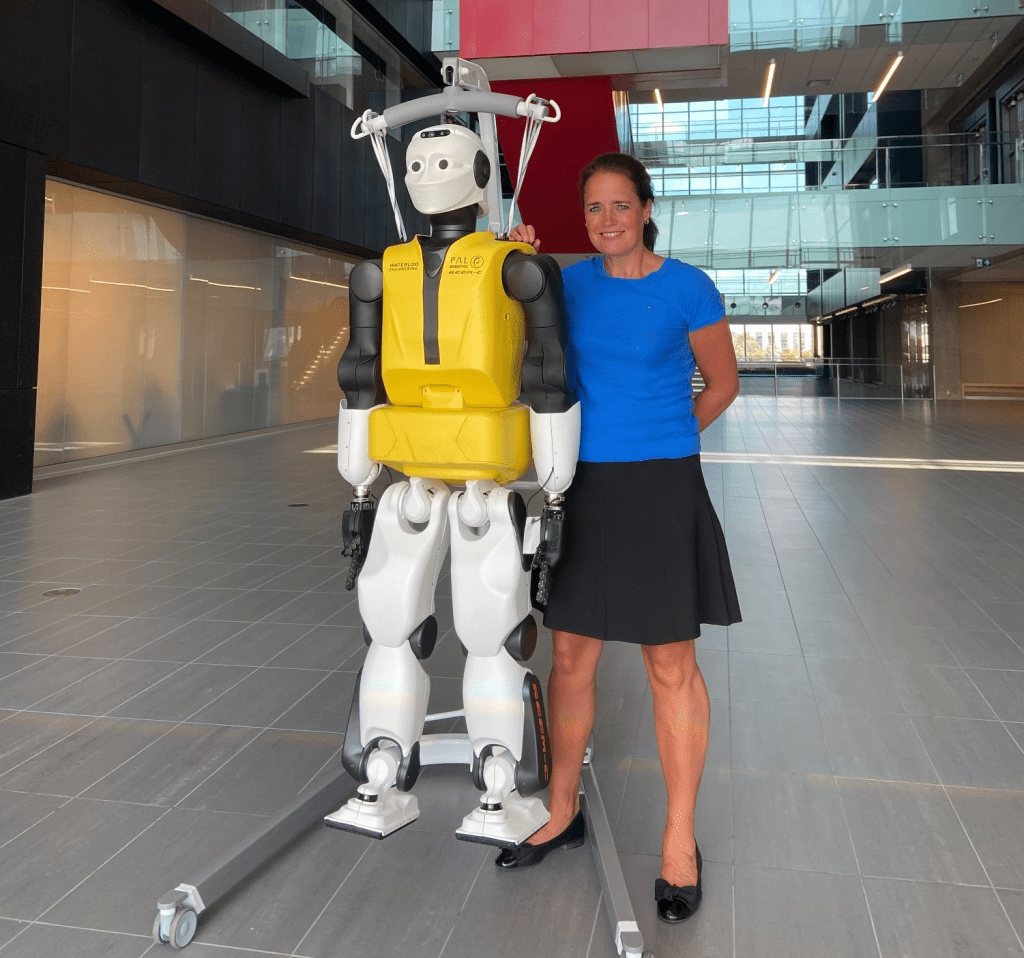
Katja Mombaur joined the Karlsruhe Institute of Technology (KIT) in Germany in 2023 as Full Professor, Chair for Optimization & Biomechanics for Human-Centred Robotics and Director of the BioRobotics Lab. In addition, she holds an affiliation with the University Waterloo in Canada where she has been Full Professor and Canada Excellence Research Chair (CERC) for Human-Centred Robotics & Machine Intelligence from 2020 – 2025. Prior to moving to Canada, she has been a Full Professor at Heidelberg University where she directed the Optimization, Robotics & Biomechanics Chair, as well as the Heidelberg Center for Motion Research.
She holds a diploma degree in Aerospace Engineering from the University of Stuttgart and a Ph.D. degree in Mathematics from Heidelberg University and has worked as a researcher at Seoul National University and at LAAS-CNRS in Toulouse. Katja Mombaur currently serves as the Vice President for Member Activities of the IEEE Robotics & Automation Society and as Senior Editor of the IEEE Transactions on Robotics and has actively contributed to the organization of many conferences and workshops. She is the KIT Spokesperson of the Helmholtz Graduate School of Information and Data Science for Health (HIDSS4Health).
Resarch vision & objectives
Katja Mombaur’s research vision is to develop human-centered robotic technology that is not an end in itself but creates value to humankind. Human-centered robotics encompasses all robotic devices that directly interact with humans or support humans in their motions. Her research is based on all three pillars of science: theory, practical experiments and scientific computing. She strives to advance our insights and their application by multidisciplinary perspectives, seeking collaboration with psychology, philosophy, ethics, medicine and cognitive sciences, engineering, computer science, computer engineering, architecture and mathematics.
Her research objectives are fourfold:
1. Develop robotic systems that enhance and facilitate people’s lifes – for people with and without disabilities
2. Endow robots with motion intelligence
3. Advance understanding and decomposition of human movement
4. Develop and implement efficient algorithms for motion generation, control and learning, combining advanced models and model-free approaches




Newsfeed
 Optimization and Biomechanics for Human-Centred Robotics